


Mohács National Memorial [temporarily closed]
Opened in 1976 after archaeological excavations, the Mohács National Memorial, then called the Mohács Historic Memorial, is located at the site of the Battle of Mohács in 29 August 1526. The park area is the final resting place of 1700 soldiers. As the 500th anniversary of the Battle of Mohács approaches, the reconstruction and expansion of the Mohács National Memorial began on October 1, 2025. The memorial will be closed during the construction works. We ask for the understanding and patience of visitors! Our common goal is to create a site worthy of the heroes of the Battle of Mohács by 2026.
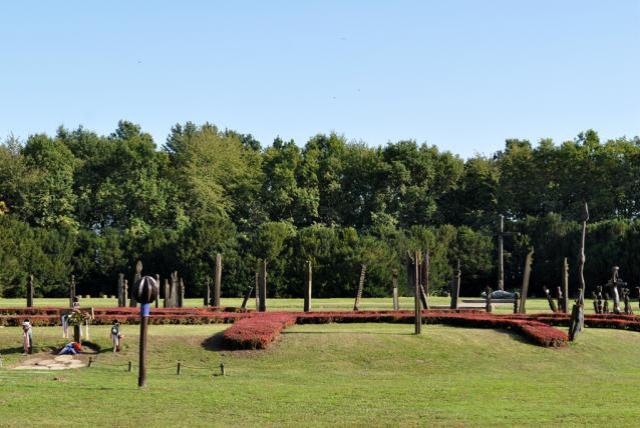
Among the mass graves are carved wooden statues of King Louis II, Sultan Suleiman, Pál Tomori, Dorottya Kanizsai and many anonymous braves. The multitude of grave marker statues reminding of weapons and horses create lively movement in the tranquillity of the graveyard. You can toll the small bell whose sound adds to the sublime atmosphere of the graveyard. The imposing exhibition and lookout building, shaped like the Holy Crown, houses exhibitions on several storeys, the exhibits ranging from period weapons to a digital battlefield utilising 21st century technical features. From the dome-shaped observation deck on the upper level, guests can take a bird's-eye view of the flower-shaped graveyard. The site, which has been officially designated the rank of a National Memorial since 2012, regularly hosts events to commemorate the battle and its historical period, and to pay tribute to the heroes. The events include guided tours of the graveyard, lectures by a military historian, displays of replicas of period weapons, historical role play sessions for children, archery, and special guided tours on the Night of Museums.
A short introduction of the Memorial
On 29 August 1526, the Hungarian troops fought a fateful battle in the outskirts of Mohács with Sultan Suleiman’s Ottoman armies. In just one and a half hours, fourteen thousand of our soldiers fell, medieval Hungary lost its king, suffered a fatal defeat, and became split into pieces. The first two mass graves of the Battle of Mohács were unearthed in 1960 owing to the work of archaeologist Dr László Papp. From then on, the city supported the establishment of the memorial, but the debates and extremist opinions that arose in the 1960s did not help implementing the idea. Actual construction works could only begin in the autumn of 1975 when another three mass graves were discovered. On 29 August 1976, on the 450th anniversary of the Battle of Mohács, the Memorial was inaugurated in front of an audience of some 10,000 people. In 2011, the memorial underwent a major transformation, with the inauguration of a new visitor building shaping the Holy Crown.
The gate to the memorial site has a gothic arch which breaks in the middle, thus symbolising the breakage in Hungary’s development which was caused as a result of the lost battle. The bronze artwork by József Pölöskei goldsmith artist consists of 14,000 bone-like elements, an artistic representation of the 14,000 Christian victims of the battle and the surrounding villages. Before entering the impressive-looking visitor building designed by György Vadász, one has to pass the sculpture Map Stone by István Bencsik. In the basement there is an exhibition space where you can see a display about the battle. The exhibition is both traditional and innovative at the same time, combining archaeological finds with Hungarian and Turkish historical sources, thus providing the visitors with a tangible reality and a historical experience of the Battle of Mohács. Three different film versions in HD quality tell us the story, each adapted to the age and specific knowledge of visitors: a special film for pre-schoolers, one for schoolchildren and adults, and one for history professionals. A meeting room and a small exhibition space are located on the first floor of the building. The uppermost floor, the dome level, is used for temporary exhibitions and houses a café and restaurant. Large glass windows allow a bird's eye view of the flower-patterned graveyard.
The sunken atrium between the visitor building and the graveyard, is an earlier work by György Vadász. Its atmosphere recalls the monasteries destroyed during the Ottoman occupation, while the white stone rose in the middle of the fountain, a work by sculptor Gyula Illés, symbolises Hungary's division into three parts, in the form of split flower shedding tears for our homeland. In a sombre tone, the plaques on the walls show poems evoking the battle. It is just a few steps from here that the flowers of memory and hope unfold in front of us. The memorial park, lined with 14,000 yew trees and a grove of hazelnut, is now revealed in its full glory.
The graveyard, hiding a multitude of symbols, is surrounded by a forest with plants native to the Carpathian Basin. The forest breaks at one point, with a wedge of Austrian pine trees in the south-west penetrating as a threatening dagger, symbolising the fateful Ottoman attack. The paths leading around the memorial site also have a symbolic message: the paths forming concentric circles return into themselves, allowing visitors to walk around the park and the Calvary of Mohács, but not offering relief or solution. Among the mass graves the wooden sculptures of King Louis II, Sultan Suleiman, Pál Tomori, Dorottya Kanizsai and many more anonymous soldiers are seen, created by artists Pál Kő, Sándor Kiss, József Király, István Szabó Jr. You can see the wind harp of the Singer, the angel-winged Queen Mary, battle axes, maces, straightened scythes, and figures of horses that died in the battle. Standing in the forest of dark brown carvings, one can almost hear the sound of the battle, the thunder of horses' hooves.
Information
info@mohacsiemlekhely.hu
+36303773408