


Babócsa Basa Garden Nature Reserve
The unique value of the Babócsa Basa Garden Nature Reserve is the historic ruin garden, a protected monument, covered by a field of daffodils.
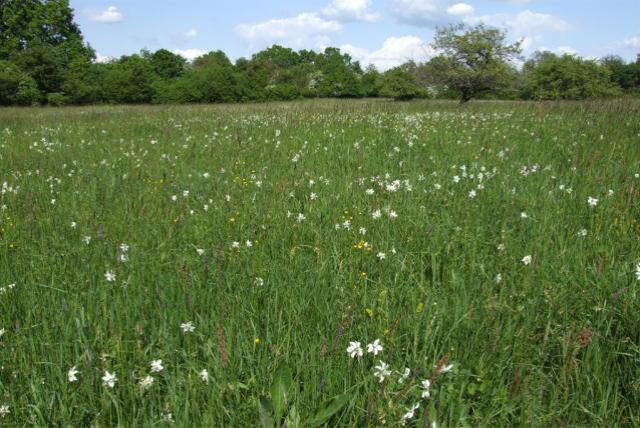
The Basa Garden hides the remains of the former Árpád era settlement, later medieval market town and finally an Ottoman settlement, all excavated in the 1980s and then reburied. Here stood an earth fortress that had the largest ground area in entire Somogy County. Of the former buildings, it is only the cca 1,5 m high wall remains of the Gothic parish church of St. Giles, that are still visible. The special feature of the Basa Garden field is the wild or starred daffodil (Narcissus stellaris) which has bloomed in the area since the Ottoman era. During the past centuries it has hybridised with the common poet’s daffodil, thus reducing its percentage in the population to about just 15%. Most of the 5-6 thousand visitors who come to the Basa Garden in one year visit here during the flowering period (late April - early May), and the area is particularly busy on the Daffodil Days. In addition to the starred daffodil (Narcissus stellaris), which is a characteristic feature of the area, the common primrose (Primula vulgaris), another protected species, is also present here. The characteristic plant association of the area is Pastinaco-Arrhenatheretum, a hayfield habitat with false oat-grass.
The site is a small protected area of mainly botanical and cultural historical importance, accordingly its fauna is limited to species that occur in the vicinity and are associated with this type of habitat.
Declared to be protected: 6/1977. OTvH decree.
Size of the protected area: 13.2 ha